An article on corrections of the influence of a rolling shutter detectors on the determination of meteor velocities has been published in the Experimental Astronomy journal
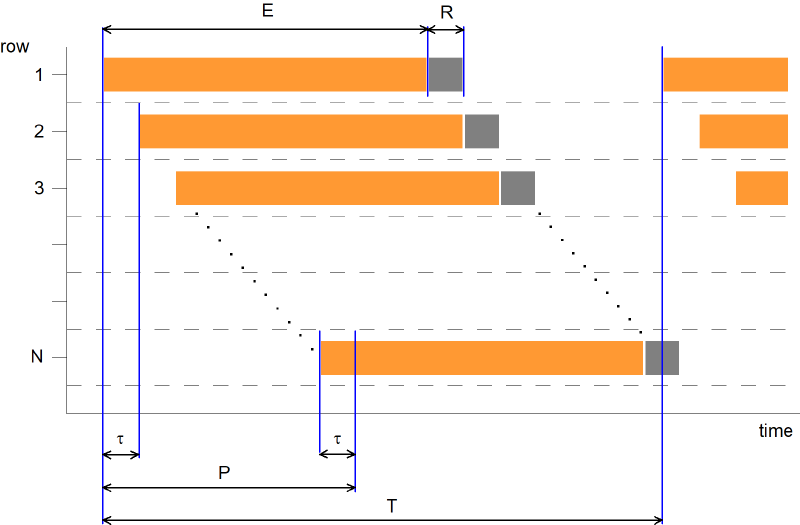
Members of our group – namely Lukáš Shrbený, Jiří Borovička, Pavel Spurný, Jan Mánek and Jan Fuchs – had an article published in Experimental Astronomy at the end of August 2026, which outlines the procedure for correctly correcting meteor images captured by cameras with a so-called rolling shutter. Unlike detectors that read out the entire surface of the sensor at the same moment (global shutter), these read out the digital sensor line by line. Reading out the entire sensor therefore takes a certain time P (Figure 1), and a fast-moving meteor is thus not displayed in the sequence of video frames with the same time interval between individual frames. This chip readout time does not depend on the number of frames recorded by the camera per second (frame rate), nor on the exposure time of individual video frames, nor on the detector resolution or other camera parameters. Most manufacturers do not specify this chip readout time for their cameras, so it is necessary to determine it in a different way. Our article presents several methods for determining this time; one of them, which yields the most accurate result, is recommended and has been used to characterise the video cameras we use to observe meteors in our network.
Previously published methods for correcting for the influence of rolling shutter on the determination of meteor velocities have replaced the sensor readout time with the reciprocal of the frame rate. Thus, if a camera were to capture 25 frames per second, the sensor readout time would be replaced by the value 1/25 = 0.04 s. This approach is incorrect, as most cameras have a sensor readout time shorter than this approximation, leading to an incorrect determination of the meteor’s velocity, which in turn affects the size and shape of its original heliocentric orbit.
Citation of the article: Shrbený, L., Borovička, J., Spurný, P. et al. Correction of the influence of rolling shutter detectors on determining the velocity of meteors from video recordings. Exp Astron 62, 14 (2026), doi.org
The official version of the article on the journal’s website.
Read-only full version of the article on SharedIt.
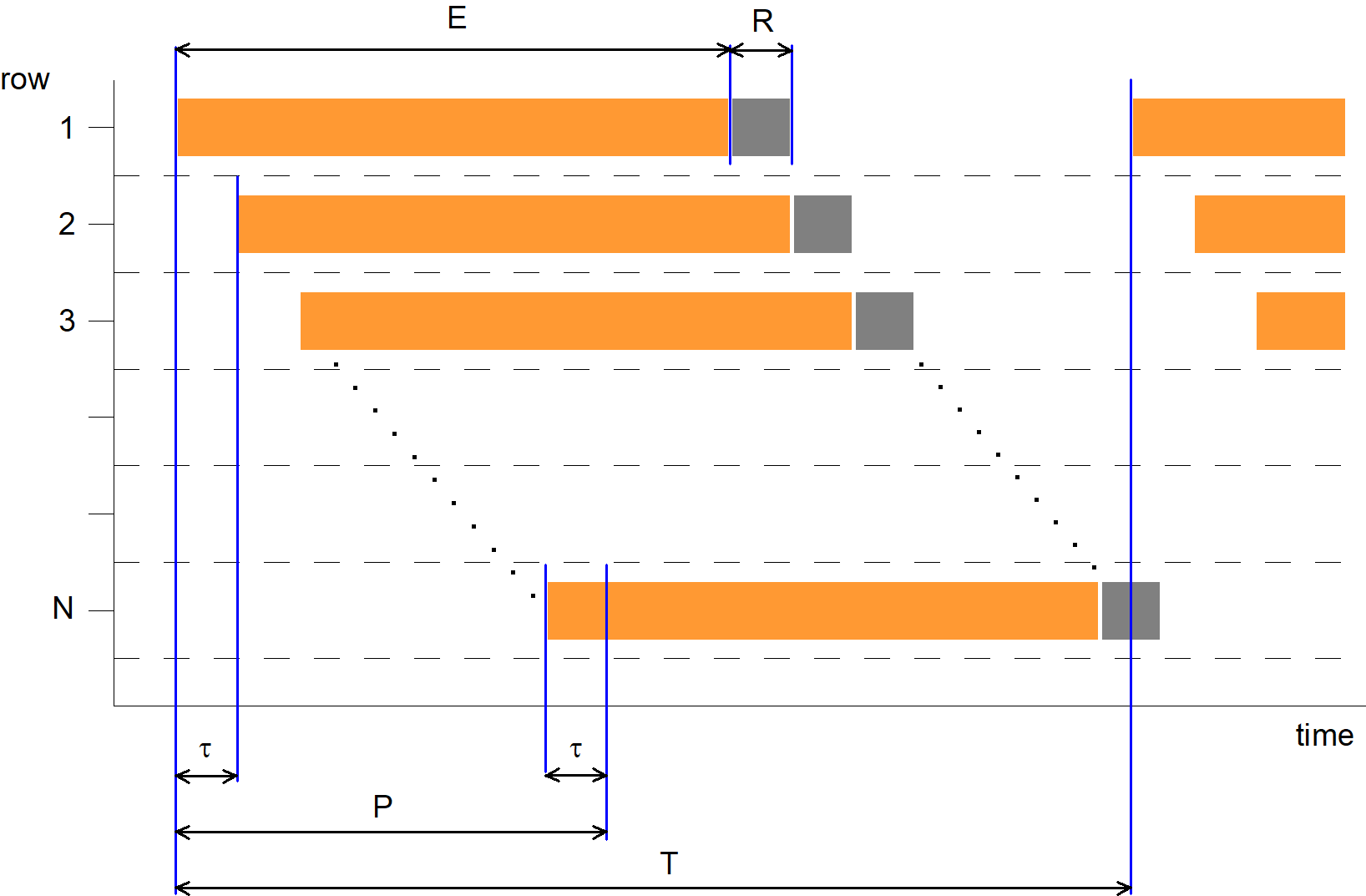
Diagram showing the sequential readout of the chip’s rows. T is the time between frames (corresponding to the reciprocal of the frame rate), R is the time taken to read data from a single row of the chip, E is the exposure time for a single video frame, τ is the time delay between the start of exposure for two consecutive rows, P is the time taken to read all rows of the chip, and N is the number of rows in the chip (corresponding to the chip’s vertical resolution in pixels). It therefore follows that P = τ*N.