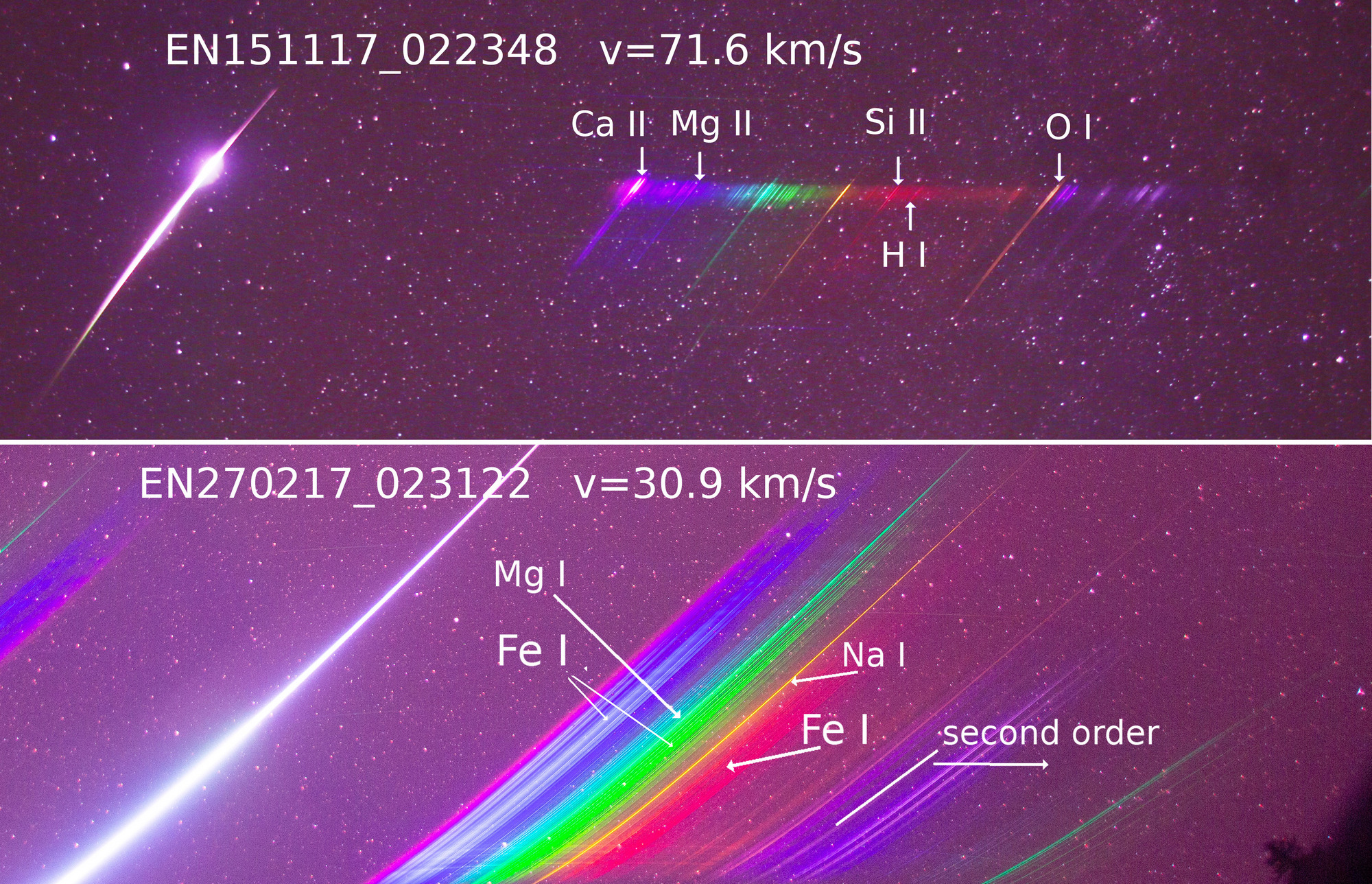
An analysis of hydrogen and silicon spectral lines in bright meteor spectra published in Astronomy & Astrophysics suggests that cometary meteoroids may have been an important source of water on Earth.

Meteor spectra provide a unique tool for studying the chemical composition and physical properties of interplanetary material entering the Earth’s atmosphere.
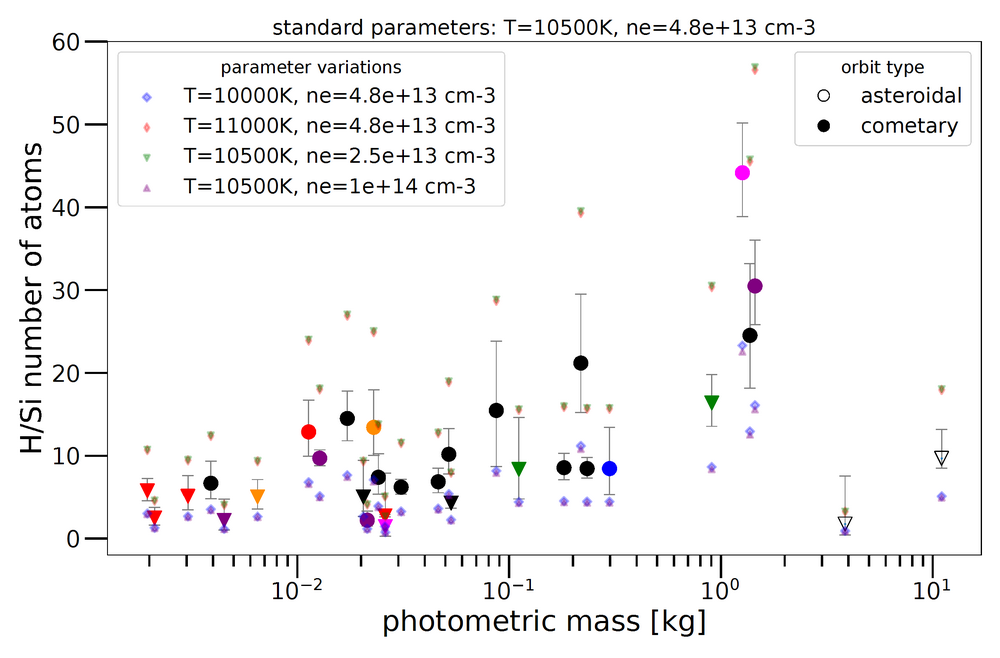
On December 18, a paper by our research group led by Vlastimil Vojáček was published in the scientific journal Astronomy & Astrophysics. The study focuses on hydrogen and silicon lines observed in photographic meteor spectra. These lines are analysed in the high‑temperature spectral component of meteors, and their relationship to the physical properties of meteoroids is investigated.
For cometary meteors, an increase in the number of hydrogen atoms with increasing meteoroid mass was found, regardless of shower association. This result indicates that larger bodies are able to retain volatile compounds more efficiently.
This woork thus supports the idea that cometary meteoroids may represent a significant source of water on Earth.
A summary of the main results is available in the section What We Are Working On on the website of the Astronomical Institute.
Article citation: V. Vojáček, J. Borovička, P. Spurný (2025): Spectroscopic analysis of hydrogen and silicon in bright fireballs: New insights into meteoroid composition, Astronomy & Astrophysics, 704, A241.
Official version of the article on the Astronomy & Astrophysics website.