The prestigious journal Nature Astronomy published a paper on the impact of asteroid 2023 CX1, in which we contributed with the analysis of the bolide and the prediction of the meteorite strewn field

The asteroid, designated 2023 CX1, was discovered on 12 February 2023 just hours before it entered the Earth’s atmosphere over the English Channel. Its tracking at a number of European observatories has made it possible to predict the time and place of its passage through the atmosphere. Thanks to this fact and favourable weather, many people have obtained images and videos of the bolide’s passage. The bolide ended over land in Normandy and systematic searches led to the discovery of a large number of small meteorites - the remains of the asteroid.
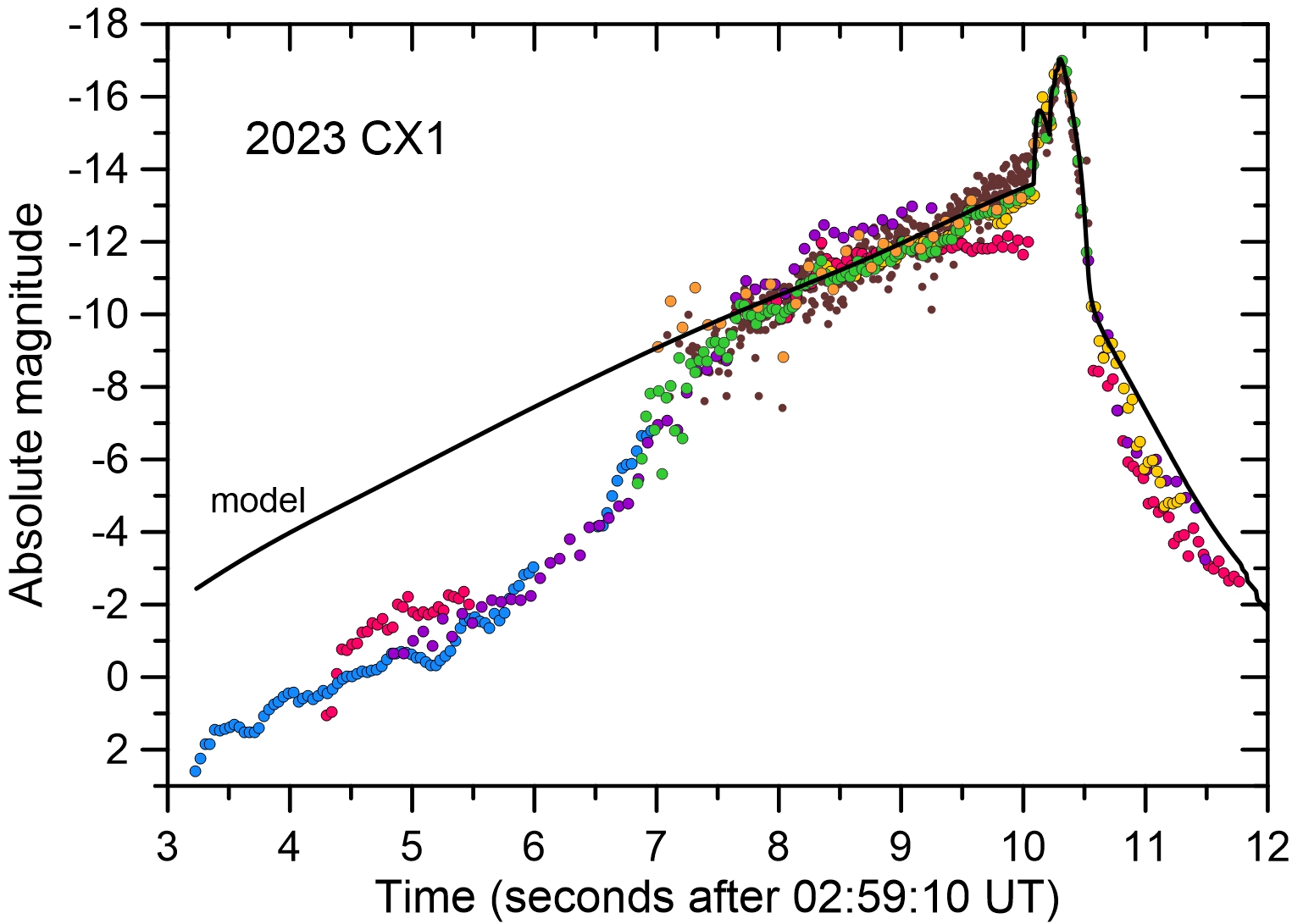
2023 CX1, measuring approximately three-quarters of a metre in size, was the seventh asteroid discovered before its collision with Earth and the third whose remnants have been found. However, it was the first time that good data on its behaviour in the atmosphere existed in addition to observations in space and analyses in the laboratory. The published paper, which was co-authored by a number of experts from many countries, combines all the available data. Jiří Borovička and Pavel Spurný from our team contributed by calculating the bolide’s trajectory, velocity and light curve, modelling fragmentation in the atmosphere and calculating the meteorite’s fall area. What was remarkable about asteroid 2023 CX1 was that it resisted significant disintegration up to an altitude of 29 km above the ground and then suddenly broke up into small pieces and dust, leading to a sharp brightening of the bolide and the creation of a shock wave.
The figure shows the light curve of the fireball and the light curve calculated from the fragmentation model, which accurately represents the bright part of the fireball.
The article, whose lead author is Auriane Egal, who now works at the Montreal Planetarium in Canada, is available to subscribers on the journal website. The preprint is freely available at arxiv.
September 18, 2025